What Are the 7 Fiduciary Duties in California Trust Administration?
October 15, 2026

If you are asking, what are the 7 fiduciary duties, the short answer is that fiduciary responsibilities are often grouped into practical principles such as loyalty, prudence, good faith, and disclosure. California trust law does not set out one universal numbered list of exactly seven duties; a trustee’s specific obligations depend on the trust and the circumstances. For help understanding a California trust administration issue, call 1 (888) 308-7003 or contact Lawvex to discuss your next step.
Ask Lawvex about trust administration
That distinction matters. A numbered list can make a complicated legal relationship easier to understand, but it should not suggest that every source uses the same seven labels or that one short checklist replaces California law. Trustees must follow the trust terms and applicable legal duties while handling another person’s property for beneficiaries. Lawvex focuses on estate planning, trust administration, and probate for California families.
What are the 7 fiduciary duties in practical terms?
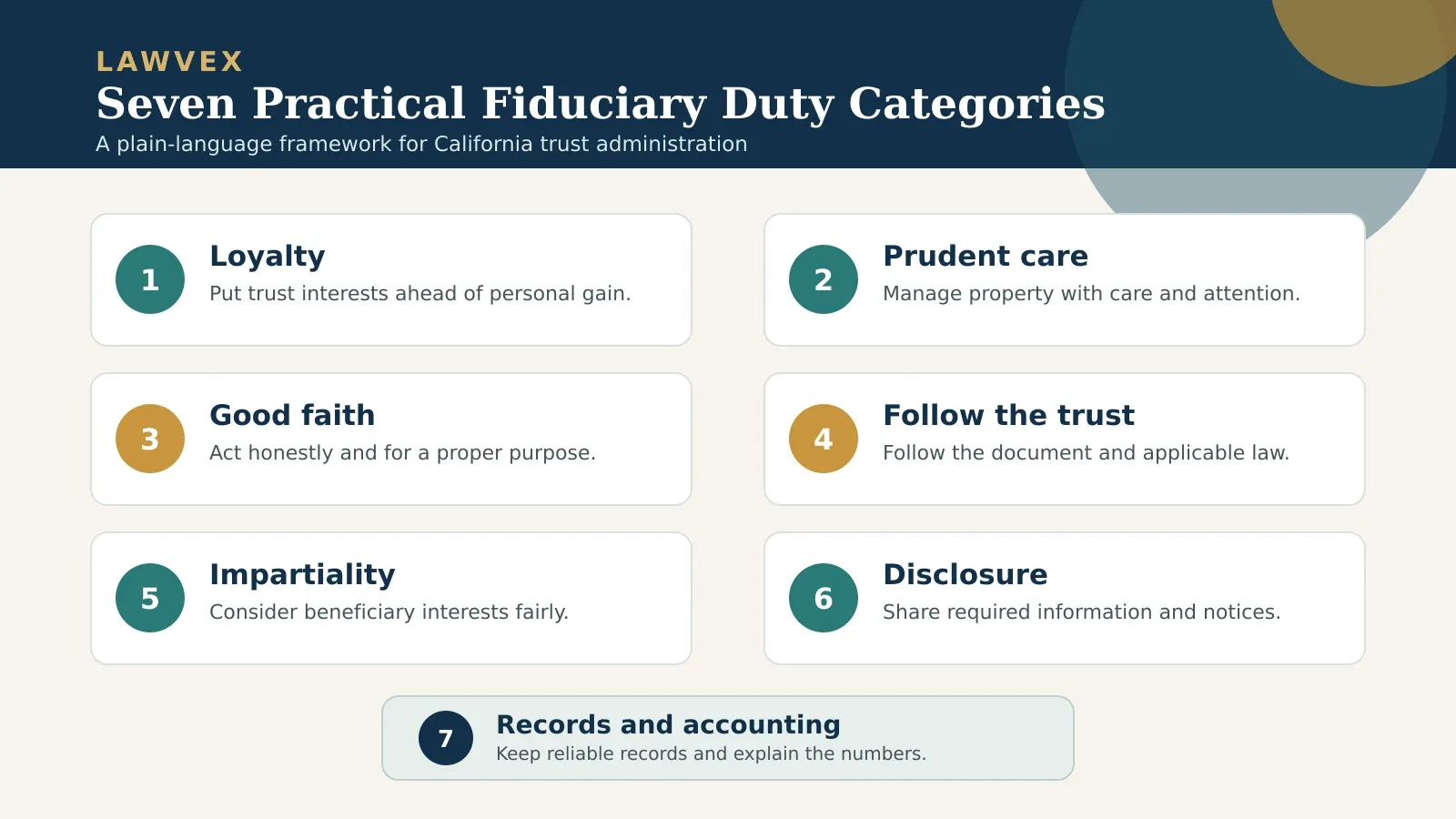
Answer in brief: The seven principles below are a useful way to organize common fiduciary responsibilities: loyalty, prudent care, good faith, following the trust, impartiality, disclosure, and accurate records and accounting. They are practical categories, not a single official California statutory checklist.
Fiduciary duties are obligations owed by someone entrusted to act for another person or entity. The Cornell Legal Information Institute describes fiduciary duty in terms of obligations such as loyalty and care, while noting that the particulars depend on context. Trust administration has its own governing documents and California rules, so a beneficiary or trustee should identify the role and facts before drawing conclusions. Read the general fiduciary-duty overview for context, not as a substitute for trust-specific California law.
| Practical principle | What it generally asks of a trustee | Example question |
|---|---|---|
| Loyalty | Put proper trust administration and beneficiary interests ahead of personal advantage. | Could this transaction benefit the trustee personally? |
| Prudent care | Manage trust property with appropriate care and attention. | Were risks, deadlines, and available information considered? |
| Good faith | Act honestly and for a proper purpose. | Is there a reasonable, trust-related basis for the action? |
| Following the trust | Administer the trust according to its terms and applicable law. | Does the document authorize this distribution or decision? |
| Impartiality | Consider the interests of beneficiaries fairly when required. | Does a decision favor one beneficiary without a proper basis? |
| Disclosure | Provide information and notices required by the trust and law. | Have beneficiaries received information they are entitled to? |
| Records and accounting | Keep reliable records and provide accounting when required. | Can transactions be traced to supporting documents? |
The table is a prompt for asking better questions, not a scorecard. One event can raise more than one issue. A sale to a business connected with a trustee, for example, might invite questions about loyalty, authority under the trust, the basis for the sale, and what information was shared. Conversely, a beneficiary’s dissatisfaction with a result does not establish that any duty was violated. Look at the actual decision, its context, and the governing document before drawing a conclusion.
1. Loyalty
Loyalty means administering the trust for its proper purposes rather than using the trustee’s position for personal gain. A potential conflict does not automatically prove misconduct, but it should be identified and handled carefully. For example, a trustee considering a transaction involving a business they own should review the trust’s terms, disclose relevant facts when required, and obtain appropriate guidance before acting. Beneficiaries concerned about a conflict can review the related discussion of trustee fiduciary duties and possible negligence concerns.
A useful first question is whether the trustee has a personal interest that could pull against the trust’s interests. Consider a proposed sale of trust property to a company connected to the trustee. Relevant facts may include how the proposed price was considered, whether the trustee had authority to proceed, what alternatives were reviewed, and whether the interest was disclosed as required. A conflict deserves careful attention, but the label alone does not determine whether the trustee acted improperly.
2. Prudent care
Prudent administration calls for reasonable attention to the trust’s property, obligations, and circumstances. It is not a promise that every investment or decision will produce a particular result. A trustee should gather relevant information, protect assets, keep deadlines in view, and make decisions consistent with the trust and applicable standards. What is prudent can depend on the asset and the trust’s purposes: handling a home, a closely held business, and a bank account may call for different steps.
For example, a home may need insurance, basic maintenance, and attention to taxes or other recurring expenses while the trustee determines what the trust permits next. A business interest may call for reviewing available financial information and understanding ongoing obligations rather than treating it like a checking account. For cash, the practical questions may include whether payments due soon can be covered and whether the records clearly show withdrawals and deposits. These are examples of issues to consider, not a universal formula for every trust.
Trustees who need a broader overview can review Lawvex’s guide to how to administer a trust, including the practical work involved in gathering information and managing trust matters.
3. Good faith
Good faith is a practical expectation of honest conduct and a proper purpose. A trustee should not use discretion as a pretext to punish a beneficiary, conceal a personal interest, or avoid a responsibility. At the same time, beneficiaries may disagree with a decision even when the trustee acted honestly and within the authority provided. The documents, communications, timing, and reasons for the decision help distinguish a disagreement from a potential breach.
Suppose a beneficiary asks for a distribution and the trustee says no. Rather than treating the refusal by itself as proof of bad faith, look for the decision’s stated reason and compare it with the trust’s language. Did the trustee explain that the request fell outside the distribution terms, or did the explanation change over time? Was the same standard applied to similar requests? Those details help make a concern specific enough to evaluate.
4. Following the trust and applicable law
A trustee’s authority comes from the trust instrument and applicable law. The trustee should read the relevant provisions before making distributions, selling property, or changing how trust assets are managed. When a document gives discretion, that does not necessarily mean unlimited discretion; its boundaries depend on the language and legal context. If the trust is unclear, guessing can create avoidable conflict.
When reviewing a trust, identify the current version and any amendments before relying on a clause. Then locate the provisions that address the asset or decision in question: who may receive distributions, what powers the trustee has, and whether the document gives instructions for a particular event. Keep the full clause in context rather than relying on a sentence copied into an email. This simple document check can reveal whether the question is about authority, timing, interpretation, or how a power was exercised.
Different assets may require different administration steps. For example, selling a trust-owned home raises practical and legal questions beyond a cash distribution. Lawvex explains some of those issues in its guide to whether a trustee can sell trust property without all beneficiaries approving. The answer depends on the trust terms, the trustee’s authority, and the facts.
5. Impartiality
When a trust has more than one beneficiary, a trustee may need to consider their interests fairly. Impartiality does not always mean identical treatment. A trust may authorize different distributions, provide for one beneficiary’s needs, or give the trustee discretion that must be exercised within stated limits. The trustee should understand the trust’s purpose and avoid favoring or disadvantaging someone for an improper reason.
For instance, a trust may provide current benefits to one person while preserving assets for others later. The trustee’s task is not to rewrite that arrangement to make everyone receive the same amount today. Rather, the trustee should apply the terms faithfully and consider the relevant interests as required. Clear records of the decision-making process can help explain how the trustee approached a difficult choice.
In practice, impartiality may require looking beyond the immediate request. If one beneficiary needs help with a particular expense and another has a future interest, the trustee may need to consider the trust’s distribution language, available assets, and the interests described in the document. Keep the reasoning tied to those terms rather than to family history or pressure from one side. Fair consideration does not guarantee that everyone will agree with the result.
6. Disclosure and communication
Trust administration can feel opaque when beneficiaries do not know what is happening. Trustees should understand what information, reports, and notices the trust and law require, and respond appropriately to requests. A beneficiary should likewise make requests clearly and keep copies of correspondence. Not every internal discussion or document is necessarily available to every person, so avoid assuming that silence or a delayed answer alone proves wrongdoing.
When a trustee is handling bills, taxes, property, and distributions at once, a simple communication plan can help: identify a point of contact, provide appropriate updates, and explain what remains unresolved. Lawvex’s resource on paying bills as a trustee covers one recurring part of administration. The full reporting obligations depend on the trust and the particular circumstances.
Beneficiaries can make a request easier to answer by naming the information sought and the time period involved. For example, “Please clarify the property-insurance payment listed in the latest records and provide the supporting invoice if available” is more focused than “Send me everything.” A trustee can acknowledge the request, explain what can be provided, and identify when a fuller response may be possible. These practical steps can reduce misunderstanding while preserving a clear record.
7. Accurate records and accounting
Reliable records make it possible to understand what the trustee received, paid, invested, and distributed. Trustees should preserve statements, receipts, invoices, tax documents, and written explanations for significant decisions. An accounting is more than a list of figures: supporting records help show where the numbers came from and how trust property changed over time.
A basic records system can organize documents by account, asset, or time period. For each payment, keep the date, amount, payee, purpose, and receipt or invoice where available. For money received, save the deposit record and note its source. If the trustee reimburses an expense, retain both proof of payment and an explanation of why it related to trust administration. Consistent naming and filing can help a successor trustee or professional reviewer follow the history without reconstructing it from scattered emails.
Beneficiaries reviewing an accounting can note specific entries they do not understand, identify missing periods or supporting documents, and ask focused questions. Avoid treating an error or unexplained entry as proof of intentional misconduct without more information. See Lawvex’s guide to trustee accounting in California for more on records and reports. Trustees may also find the successor trustee duties checklist useful when organizing responsibilities after a change in trusteeship.
What are the 7 fiduciary duties when reviewing a California trust?
Answer in brief: California trustees must administer the trust under its terms and applicable law. The seven categories are a plain-language framework; the trust document, the trustee’s actions, and the people involved determine which specific duties matter.
Consider a trustee who plans to sell a home owned by a trust, pay expenses, and distribute the remaining proceeds. The trustee may need to confirm authority under the trust, understand relevant property and financial information, consider beneficiary interests, communicate as required, and retain records of the sale and payments. These responsibilities overlap. A decision that raises a loyalty concern may also prompt questions about disclosure, documentation, or whether the trustee followed the trust.
One practical way to assess such a situation is to separate the sequence into stages. Before a sale, identify the authority and any conditions in the trust. During the process, keep information about the property, proposed terms, and material decisions together. Afterward, retain the closing statement, receipts for expenses, deposit information, and records of any distribution. If a beneficiary asks about the transaction, a clear explanation linked to the records can help show what happened without asking the reader to infer it from a single bank entry.
The legal labels are less important than the facts and the governing provisions. A dispute about the timing of a distribution, for example, is different from a claim that a trustee diverted assets for personal use. Likewise, a beneficiary’s right to information can depend on the trust and the beneficiary’s status. For a general introduction to California inheritance processes, see Lawvex’s California probate pathway. Probate and trust administration are distinct processes, though a family may encounter both.
Trustees should avoid making a major distribution or asset transfer based only on an informal family agreement if the trust or law calls for a different process. Beneficiaries should preserve relevant letters, statements, and account records, and make reasonable written requests for clarification. Either side can benefit from sorting the timeline and documents before escalating a disagreement.
What can a trustee or beneficiary do when a duty is in question?
Answer in brief: Start with the trust document and a clear record of events. Identify the decision or information gap, ask focused questions, and seek legal guidance when the concern involves meaningful assets, a conflict, or a possible breach.
These steps can help organize the issue without assuming the outcome:
- Locate the governing documents. Find the trust and any amendments, plus relevant deeds or account records. Note provisions about the trustee’s powers, distributions, and reports.
- Write down the concern precisely. Identify the action, date, property, people affected, and why it appears inconsistent with a duty or trust term. Separate known facts from assumptions.
- Request relevant information in writing. Ask concise questions and retain copies of the request and response. A specific question is usually easier to address than a broad accusation.
- Preserve supporting materials. Keep communications, statements, invoices, notices, and any accounting received. Do not alter or discard records.
- Get advice before taking a high-stakes step. A trustee facing a conflict or uncertain authority, or a beneficiary considering a formal challenge, should understand the applicable process and deadlines before acting.
It can help to prepare a short chronology before a call or meeting. List the relevant dates, who took each action, what document supports it, and what remains unclear. Keep observations separate from conclusions: “The distribution was requested on May 2 and no response is in the file” is a verifiable note; “the trustee is hiding money” is an allegation that requires evidence. This distinction can make a discussion more productive and help a professional identify what additional documents matter.
There may be ways to address a concern informally, but not every dispute can be resolved through conversation alone. A legal professional can review the trust, records, and relevant California rules and explain possible options without promising a particular result. Lawvex serves California families with estate planning, trust administration, and probate matters. For a discussion, call 1 (888) 308-7003 or contact Lawvex.
Contact Lawvex to discuss a California trust administration concern
Frequently asked questions
Answer in brief: The seven duties are a helpful summary, but a trustee’s legal obligations are determined by the trust, applicable law, and the facts.
Are there exactly seven fiduciary duties under California law?
No single numbered list of exactly seven applies to every fiduciary relationship. The seven principles in this article organize common trustee responsibilities in plain language. Specific legal duties may be described or grouped differently depending on the context.
Does a trustee have to treat every beneficiary the same?
Not necessarily. A trustee may need to act impartially, but that does not always require equal distributions or identical treatment. The trust may define different interests or authorize discretion, and the trustee must apply those terms appropriately.
Does a trustee’s mistake automatically mean a breach of duty?
No. A mistake, delay, or disagreement does not by itself establish a breach. The trust terms, the trustee’s authority, the surrounding facts, and any harm or corrective action may all matter. A review of the relevant records can help clarify the concern.
What should I do if I think a trustee is hiding information?
Keep a record of what you requested and when, identify the information you believe is missing, and make a focused written request. If the issue remains unresolved or involves significant property, consider getting legal advice about the information rights and remedies that may apply.
What is a sensible next step?
Answer in brief: Use the seven principles as a way to frame questions, not as a substitute for reviewing the trust and California law. The most useful next step is to identify the relevant document, action, or missing information.
If you are administering a trust or trying to understand a trustee’s conduct, organize the documents and write down the specific concern before making a decision. Lawvex can discuss trust administration and related estate matters with California families. Call 1 (888) 308-7003 or contact Lawvex to talk through next steps.
This article provides general information, not legal advice. Trust and estate matters depend on the specific documents and facts; consult a qualified California attorney about your situation.