Will vs. Trust in California: Key Differences, Costs, and How to Choose
March 18, 2026
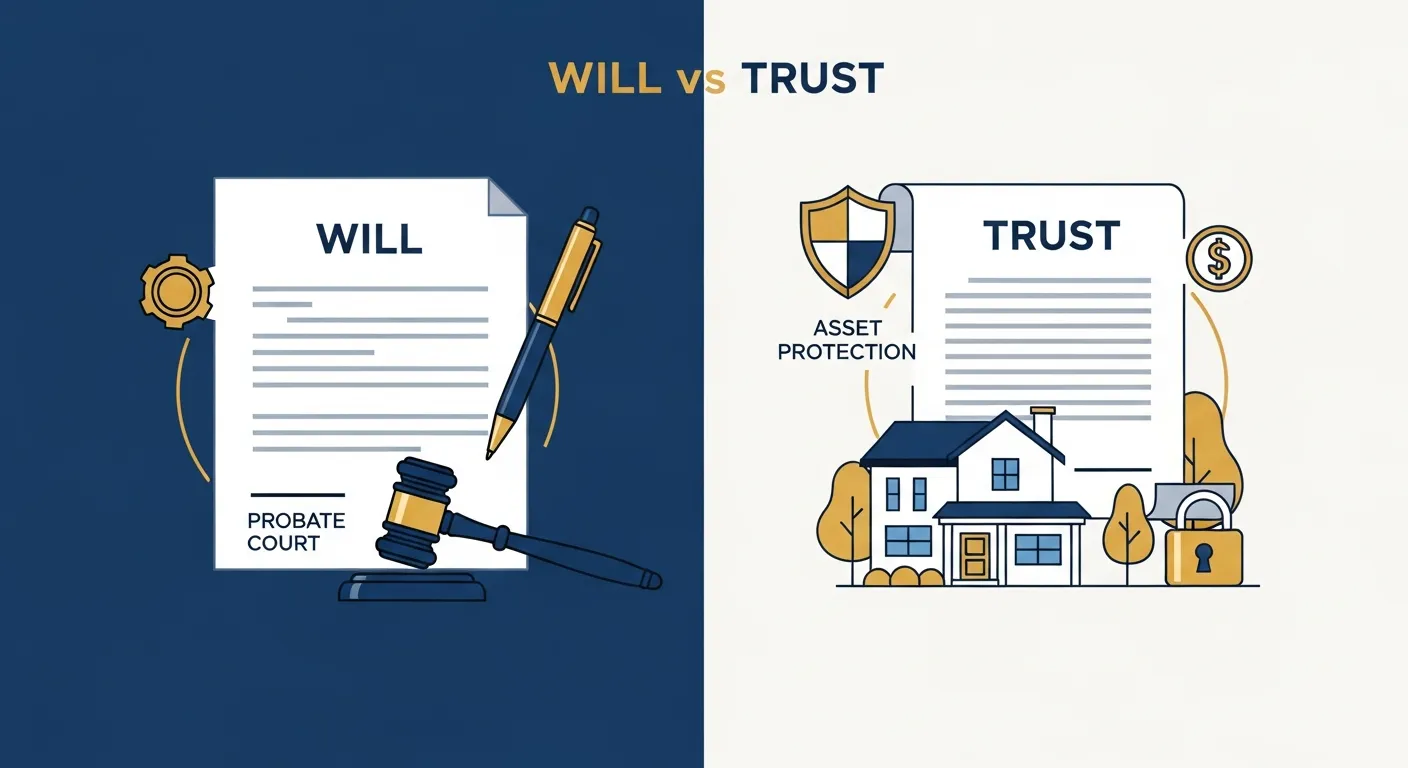
Will vs. Trust in California: Understanding the Key Differences
If you own a home in California or have assets you want to protect, you’ve likely asked yourself: should I get a will or a trust? It’s one of the most common estate planning questions, and the answer depends on your financial situation, your family, and your goals.
Both wills and trusts are legal tools that help you control what happens to your assets after you pass away. But they work very differently under California law, and choosing the wrong one can cost your family thousands of dollars and months of unnecessary court proceedings.
This guide breaks down the difference between a will and a trust under California law, including costs, probate implications, privacy, and when each option makes the most sense for your situation.
Lawvex's California guidance on wills versus trusts in California is now clear and current.
What Is a Will?
A will (sometimes called a “last will and testament”) is a legal document that states how you want your assets distributed after your death. In California, a valid will must meet the requirements set forth in California Probate Code §6110:
- You must be at least 18 years old
- The will must be in writing
- You must sign the will (or have someone sign it in your presence and at your direction)
- At least two witnesses must sign the will, acknowledging they watched you sign it
A will only takes effect after you die. Until then, you can revoke or change it at any time. When you pass away, your will must go through probate, the court-supervised process of validating the will, paying debts, and distributing assets.
What Is a Trust?
A trust is a legal arrangement where you (the “trustor” or “settlor”) transfer ownership of your assets to a trust, managed by a trustee for the benefit of your beneficiaries. Under California Probate Code §15200, a trust is created when a person with the capacity to transfer property expresses the intent to create a trust.
The most common type for estate planning is a revocable living trust. With this type of trust, you typically serve as both the trustor and the trustee during your lifetime, maintaining full control of your assets. You name a successor trustee who takes over management if you become incapacitated or after you pass away.
Unlike a will, a properly funded trust avoids probate entirely. Assets held in the trust pass directly to beneficiaries according to your instructions, without court involvement.
Will vs. Trust: Side-by-Side Comparison
Here is a comprehensive comparison of the key differences between wills and trusts in California:
| Feature | Will | Trust |
|---|---|---|
| Probate Required | Yes, must go through probate court | No, avoids probate entirely |
| Privacy | Public record once filed with the court | Private, not filed with any court |
| When It Takes Effect | Only after death | Immediately upon creation and funding |
| Incapacity Protection | None; requires a separate conservatorship | Yes; successor trustee manages assets |
| Cost to Create | $500 to $1,500 (typical in California) | $2,000 to $5,000+ (typical in California) |
| Cost to Settle | Probate fees: 2-4% of estate value | Minimal administrative costs |
| Time to Settle | 12 to 24 months (probate) | Weeks to a few months |
| Can Name Guardians | Yes, for minor children | No; still need a will for this |
| Contest Risk | Higher; probate provides a forum for challenges | Lower; harder to contest outside probate |
| Ongoing Maintenance | Minimal | Must keep trust funded with assets |
Pros and Cons of a Will in California
Advantages of a Will
- Lower upfront cost: A basic will typically costs $500 to $1,500 with an attorney in California
- Simplicity: Straightforward to create and easy to understand
- Guardian designation: The only legal way to name a guardian for your minor children
- Suitable for simple estates: If your assets are minimal and straightforward, a will may be sufficient
Disadvantages of a Will
- Requires probate: Your estate must go through California’s probate process, which can take 12 to 24 months
- Expensive to settle: California probate fees are set by statute (Probate Code §10810) and can be substantial. For a $1 million estate, statutory attorney and executor fees alone total $46,000
- Public record: Wills become public documents once filed with the probate court
- No incapacity protection: A will does nothing for you if you become incapacitated. Your family may need to seek a court-supervised conservatorship
- Easier to contest: The probate process provides a formal mechanism for beneficiaries and heirs to challenge the will
Pros and Cons of a Trust in California
Advantages of a Trust
- Avoids probate: Assets in the trust bypass California’s lengthy and expensive probate process
- Privacy: Trust documents are never filed with the court, keeping your financial affairs private
- Incapacity protection: If you become unable to manage your affairs, your successor trustee can step in immediately without court intervention
- Faster distribution: Beneficiaries can receive assets within weeks rather than waiting over a year for probate to conclude
- Harder to contest: Without a public probate proceeding, trust challenges require a separate legal action, which is more difficult and expensive for challengers
- Control over distributions: You can set conditions, stagger distributions over time, or protect assets from a beneficiary’s creditors
Disadvantages of a Trust
- Higher upfront cost: Creating a trust typically runs $2,000 to $5,000 or more in California
- Must be funded: A trust only works if you actually transfer assets into it. An unfunded trust is essentially useless and your assets will go through probate anyway
- Ongoing maintenance: New assets (property, accounts, investments) must be titled in the name of the trust
- Doesn’t cover everything: You still need a “pour-over will” to catch any assets not transferred to the trust and to name guardians for minor children
California Probate: Why It Matters for Your Decision
Understanding California’s probate process is critical when deciding between a will and a trust. California has one of the most expensive probate systems in the country because attorney and executor fees are set by statute under California Probate Code §10810.
The statutory fee schedule is based on the gross value of the estate (not the net value after debts):
- 4% of the first $100,000
- 3% of the next $100,000
- 2% of the next $800,000
- 1% of the next $9,000,000
For a California home valued at $800,000 with a $400,000 mortgage, the probate fees are calculated on the full $800,000. That means $18,000 in attorney fees and $18,000 in executor fees, totaling $36,000, even though the actual equity is only $400,000.
A trust avoids all of these fees. For most California homeowners, the cost of creating a trust is a fraction of what their family would pay in probate fees.

Revocable vs. Irrevocable Trusts: What’s the Difference?
Not all trusts are the same. The two main categories are:
Revocable Living Trust
This is the most common type of trust for estate planning. You retain full control and can modify or revoke the trust at any time during your lifetime. Assets in a revocable trust are still considered yours for tax purposes and are not protected from creditors during your lifetime. However, they avoid probate and provide incapacity protection.
Irrevocable Trust
Once established, an irrevocable trust generally cannot be changed or revoked without the consent of the beneficiaries. Because you give up control of the assets, they are typically:
- Protected from your creditors
- Removed from your taxable estate (for estate tax purposes)
- Potentially shielded from Medi-Cal recovery under certain conditions
Under California Probate Code §15400, a trust is revocable unless the trust instrument expressly makes it irrevocable. This means if your trust document is silent on revocability, California law presumes it can be revoked.
Privacy: A Major Factor in California
One often-overlooked advantage of a trust is privacy. When a will goes through probate in California, it becomes a public court record. Anyone can look up the details of your estate, including:
- What assets you owned and their values
- Who your beneficiaries are and what they received
- Any debts or claims against your estate
- Personal family information included in court filings
A trust, by contrast, is a private document. It is never filed with the court. Only the trustee and beneficiaries have a right to see its terms (and even then, only relevant portions, per California Probate Code §16061.7). If trust disputes arise, understanding how to contest a trust is essential. For families who value discretion, this alone can be a compelling reason to choose a trust.
When You Need a Will vs. a Trust in California
A Will May Be Sufficient If:
- Your total estate is worth less than $184,500 (California’s current small estate threshold under Probate Code §13100, which allows simplified transfer without full probate)
- You don’t own real property in California
- Your assets are primarily held in accounts with beneficiary designations (life insurance, retirement accounts)
- You need to name a guardian for minor children (you need a will for this regardless)
A Trust Is Strongly Recommended If:
- You own a home or real estate in California
- Your estate exceeds $184,500 in value
- You want to avoid California’s expensive probate process
- You want to keep your estate plan private
- You have blended family considerations or complex distribution wishes
- You want incapacity protection without court involvement
- You own property in multiple states (avoiding probate in each state)
For most California homeowners, a trust is the more cost-effective choice in the long run. The upfront cost of creating a trust is typically far less than the probate fees your family would face with just a will.
Cost Comparison: Will vs. Trust in California
Let’s look at the real-world costs for a California family with a $1 million estate:
| Cost Category | Will (with Probate) | Trust (No Probate) |
|---|---|---|
| Creation Cost | $500 – $1,500 | $2,000 – $5,000 |
| Attorney Probate Fees | $23,000 (statutory) | $0 |
| Executor/Administrator Fees | $23,000 (statutory) | $0 |
| Court Filing Fees | $435 – $500+ | $0 |
| Trust Administration Costs | $0 | $2,000 – $5,000 |
| Total Estimated Cost | $47,000 – $48,000 | $4,000 – $10,000 |
| Time to Settle | 12 – 24 months | 4 – 8 weeks |
As this comparison shows, for a $1 million estate, a trust can save your family approximately $38,000 or more in fees and more than a year of waiting.
How to Decide: Will, Trust, or Both?
In most cases, a comprehensive estate plan in California includes both a trust and a will. Here’s why:
- The trust holds your major assets (home, investments, bank accounts) and ensures they pass to your beneficiaries without probate
- A pour-over will acts as a safety net, directing any assets not in the trust to be transferred into it after your death
- The will is also where you name guardians for minor children, which cannot be done through a trust
A complete estate plan typically also includes a durable power of attorney, an advance healthcare directive, and beneficiary designation reviews.
Questions to Ask Yourself
- Do I own real property in California?
- Is my estate worth more than $184,500?
- Do I want to avoid the time and expense of probate?
- Is privacy important to me?
- Do I have minor children who need a guardian?
- Do I have complex distribution wishes (staggered distributions, conditions, special needs beneficiaries)?
If you answered “yes” to questions 1 through 4, a trust is almost certainly the right foundation for your estate plan. If you answered “yes” to question 5, you also need a will.
Take the Next Step
Estate planning isn’t one-size-fits-all. The right choice between a will and a trust depends on your specific situation, your assets, and your family’s needs. At Lawvex, we help families across Clovis, Madera, and Solvang create estate plans that protect what matters most.
Whether you’re starting from scratch or updating an existing plan, we can help you understand your options and choose the right approach for your family.
Learn more about our estate planning services or attend a free workshop to get your questions answered.
About the Author: Gary Winter is the founder and CEO of Lawvex, with over 19 years of experience in estate planning, business planning, and real estate matters throughout California. He is an Adjunct Faculty member and Professor of Legal Technology at San Joaquin College of Law, a member of the Board of Directors of the Clovis Chamber of Commerce, and a licensed airline transport pilot. Gary is dedicated to helping California families achieve drama-free inheritance through modern, transparent estate planning.
Disclaimer: This article is for educational and informational purposes only and does not constitute legal advice. Every situation is unique, and laws change over time. California Probate Code sections referenced are current as of the date of publication. Please consult with a qualified estate planning attorney before making decisions about your estate plan.