Update Estate Plan After Divorce in California
May 18, 2026
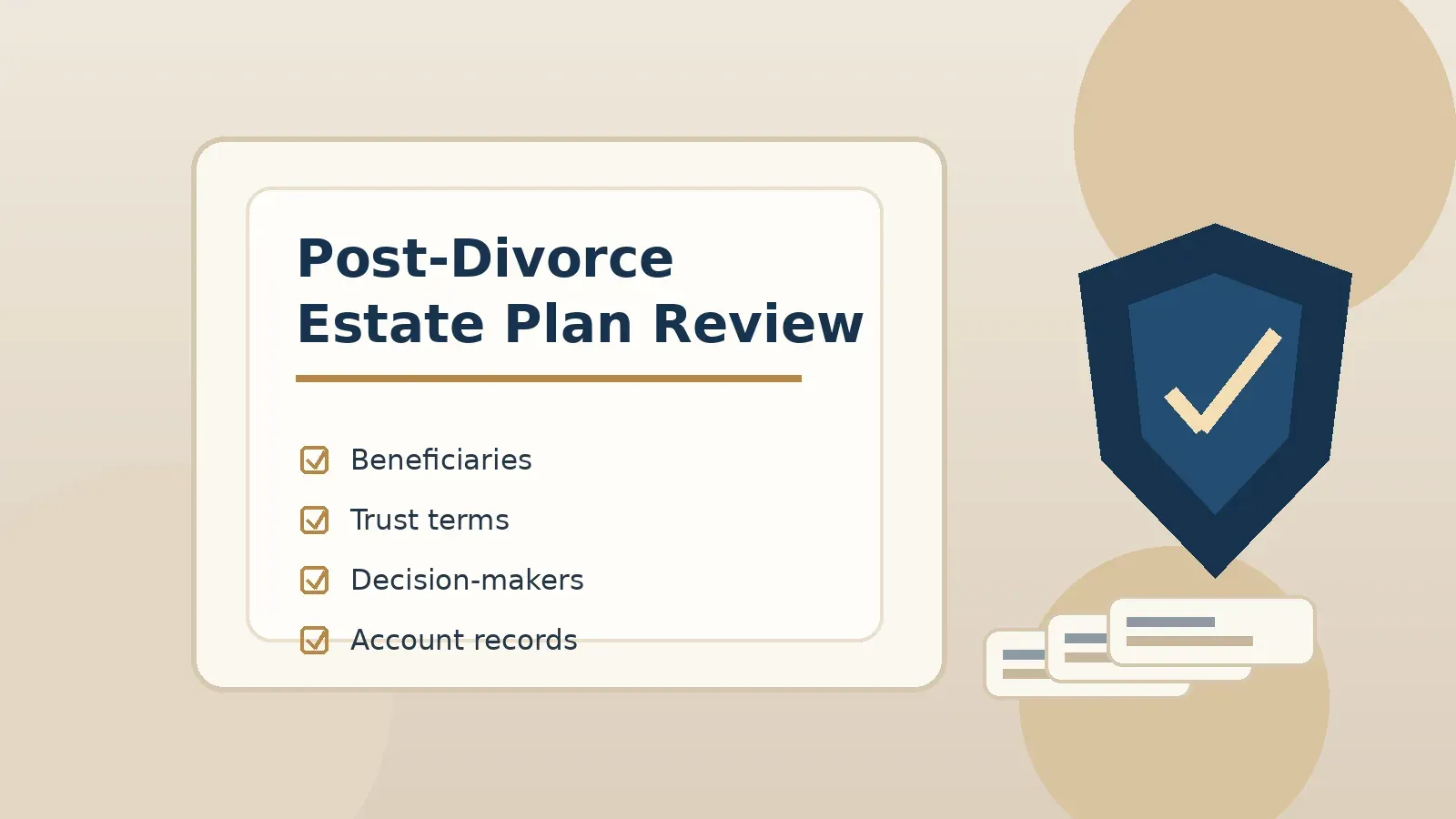
Update Estate Plan After Divorce in California: A Practical Checklist
If you need to update estate plan after divorce California documents and account records should be reviewed together, because the judgment may end the marriage, but it does not automatically make every old document, account, and backup decision-maker reflect your new wishes. A will, trust, financial power of attorney, health care directive, beneficiary designation, and property record can each follow different rules. A careful post-divorce review helps you see what still works, what should change, and what deserves legal advice before you sign anything.
Ready to rebuild your plan with confidence? Explore Lawvex estate planning services and request a strategy session for California guidance tailored to your documents.
This article focuses on the post-divorce review, after a marriage has been dissolved or annulled. If you are still separated, negotiating a settlement, or waiting for a final judgment, start with Lawvex’s pre-divorce estate planning guidance. During a pending divorce, court orders, property rights, and the terms of a joint trust can limit what may be changed.
What California divorce changes, and what it does not
California law does revoke some former-spouse roles after a divorce, but relying on default rules is not the same as having a current plan. Probate Code section 6122 generally revokes will gifts and fiduciary nominations for a former spouse after dissolution or annulment, unless the will says otherwise. Probate Code section 4154 revokes a former spouse’s designation as attorney-in-fact under a power of attorney. Probate Code section 4697 does the same for a former spouse named as health care agent.
Nonprobate transfers require their own review. Probate Code section 5040 may cause certain revocable nonprobate transfers to a former spouse to fail after divorce, but the statute has exceptions, and it expressly does not cover life insurance policies. Employer retirement plans and plan-administrator rules can also raise issues beyond a simple estate planning document review. The practical lesson is simple: statutes can reduce some risk, but they do not tell your bank, insurer, retirement plan, trustee, or family exactly what you want now.
| Item to review | Why it matters after divorce | Practical next step |
|---|---|---|
| Will | Former-spouse gifts or nominations may be revoked by law, but alternates may be outdated. | Confirm beneficiaries, executor, guardians, and backup provisions. |
| Revocable trust | Trust terms, trustee succession, and asset schedules may not match the post-divorce plan. | Review amendment rights, trustee roles, distributions, and funding records. |
| Financial power of attorney | A former spouse’s authority may end by statute, but you still need a trusted replacement. | Sign an updated document and coordinate notice where appropriate. |
| Advance health care directive | The old agent designation may be revoked, leaving a practical gap in medical decision-making. | Name a new primary agent and at least one backup if that fits your wishes. |
| Beneficiary forms | Account-level forms may control life insurance, retirement assets, and payable-on-death accounts. | Request current forms from each institution and update them intentionally. |
Step 1: Gather the documents before making changes
Start with a complete file. Many people remember the trust binder and forget the separate account forms that move money outside probate. Pull together the signed estate planning documents, the final divorce judgment, any marital settlement agreement, property division orders, deeds, business records, life insurance beneficiary forms, retirement plan forms, transfer-on-death paperwork, payable-on-death bank instructions, and contact information for named fiduciaries.
If you cannot find the latest signed versions, that is useful information. A post-divorce review should not be based on memory or a draft saved in email. Institutions, successor trustees, and courts work from executed documents and account records, not from what someone intended to update later.
- Locate the will, trust, amendments, certification of trust, and property schedules.
- Find the durable financial power of attorney and advance health care directive.
- Pull account statements that show beneficiary or transfer-on-death designations.
- Note any property awarded in the divorce that was formerly held jointly or in a joint trust.
- Create a list of every person named to act for you, not just every person named to inherit.
Step 2: Recheck beneficiaries across the whole plan
Beneficiary review is usually the first concern after divorce, but it should not become a one-person search-and-replace exercise. Removing a former spouse may leave an outdated contingent beneficiary, a deceased relative, a minor child named outright, or an allocation that no longer matches the divorce settlement. Review the chain of distributions, not just the first name on the page.
For a will or revocable trust, ask whether the beneficiaries, percentages, charitable gifts, and special gifts still fit. For accounts that use separate forms, ask the custodian or plan administrator what designation is currently on file. Life insurance, IRAs, employer plans, annuities, payable-on-death accounts, and transfer-on-death registrations may not all follow the same process or the same legal result.
A good review also checks how children and blended-family goals fit after divorce. If minor children may inherit, consider whether a trust structure, staged distributions, or a responsible trustee is more practical than an outright gift. If adult children from different relationships are involved, clarity becomes even more important. Lawvex’s broader estate planning process is designed to address these family questions in a coordinated plan, not as disconnected edits.
Step 3: Review successor trustees, executors, and decision-makers
Estate planning is not only about who receives property. It is also about who can manage responsibilities when you cannot. A divorce often changes the person you would trust as executor, successor trustee, financial agent, health care agent, conservator nominee, or guardian nominee. California law may revoke some former-spouse roles after divorce, but that still leaves a practical question: who should serve instead?
Look at primary and backup appointments. If the old plan named a former spouse first and a sibling who now lives far away second, the legal backup may exist but no longer be the best fit. The same is true if an adult child is now more prepared to serve, or if a person named years ago is no longer healthy, available, or aligned with your wishes.
- Executor or personal representative under the will
- Successor trustee under the trust
- Agent under a durable financial power of attorney
- Agent under an advance health care directive
- Guardian nominations for minor children, if relevant
- Advisers or trust protectors named in more customized plans, if any
If a trustee may eventually manage real estate, family business interests, or a difficult beneficiary situation, name someone who can handle those duties or who will ask for professional help. The right fiduciary choice can prevent years of avoidable confusion.
Step 4: Decide whether trust terms need a full refresh
A revocable living trust should be read as a system. Divorce can affect trustee succession, definitions of spouse, distribution language, tax planning clauses, property characterization, personal property instructions, and the asset schedule attached to the trust. If your trust was created as a joint trust during marriage, the divorce judgment and the trust’s amendment or revocation provisions deserve close review.
Do not assume that signing a brand new trust automatically fixes an older joint trust. Lawvex’s pre-divorce resource discusses a real-world concern: specific notice and revocation steps may matter when a joint trust is involved. After the divorce is final, the review should confirm what document now controls, what property is actually titled in the trust, and whether the trustee succession matches your new plan.
This is also the point to evaluate whether a restatement is cleaner than multiple narrow amendments. If the old plan has marital clauses, outdated alternates, superseded property references, and scattered changes, a coordinated refresh may be easier for family members to administer later.
If your trust still reads like a married-couple plan, pause before making piecemeal edits. Talk with Lawvex about a coordinated estate plan review so the trust, will, powers of attorney, and beneficiary strategy work together.
Step 5: Replace financial and medical decision documents
Even where California law revokes a former spouse’s authority after divorce, signing fresh incapacity documents can reduce delay and uncertainty. A bank, hospital, or family member may not know your divorce status immediately. A current power of attorney and advance health care directive give them clearer instructions and give your chosen agents documents that reflect the present.
Review the financial power of attorney for who may pay bills, manage property, communicate with institutions, handle digital access if authorized, and step in during incapacity. Lawvex’s California durable power of attorney guide explains why the role matters even for people who already have a trust.
Review the advance health care directive for the primary agent, alternates, care preferences, organ donation choices if included, and the practical contact information your family may need. If you want a different person to receive medical updates or coordinate with doctors, make the document reflect that intention clearly.
Step 6: Update account forms, ownership records, and real estate details
One of the most common post-divorce gaps is assuming the estate plan controls every asset. It does not. Beneficiary designations and ownership records often decide what happens first. Review the paperwork for life insurance, retirement plans, bank accounts with payable-on-death features, brokerage accounts with transfer-on-death registrations, pensions, deferred compensation, health savings accounts where applicable, and any business buy-sell or succession documents.
For retirement assets and insurance, request the current beneficiary record rather than relying on an old screenshot or a memory of what was submitted. For real estate, confirm whether deeds, trust transfers, and title records match the divorce judgment and your updated plan. If a home or rental property was awarded to one spouse, the estate plan and title record should tell the same story.
Digital assets also deserve attention. Password managers, domain names, online financial portals, cloud photo libraries, and cryptocurrency records can create administration problems if the plan says one thing and access instructions say another. The legal authorization and the practical inventory should be reviewed together.
Step 7: Coordinate the divorce judgment with the estate plan
Your estate planning attorney should know if the divorce judgment requires ongoing obligations, such as maintaining life insurance, securing support, transferring a property interest, preserving a retirement interest under a court order, or honoring terms that affect business ownership. An estate plan should not accidentally conflict with a binding court order or settlement requirement.
This is especially important when a judgment leaves continuing financial ties between former spouses or protects children from the marriage. A simple “remove my ex everywhere” instruction may be wrong if the court order requires a specific beneficiary arrangement for a period of time. Bring the final judgment and any related orders to the review meeting.
Step 8: Tell the right people and store the new plan well
A signed update helps only if the right people can find it when needed. Store the current plan where your chosen fiduciaries can access it. Tell the person named as successor trustee, executor, financial agent, or health care agent that they have been nominated. You do not need to reveal every private detail, but you should reduce the chance that no one knows which document is current.
Consider whether financial institutions, medical providers, or prior agents should receive updated documents or revocation notices based on your attorney’s advice. Keep a simple checklist showing when each institution acknowledged an updated beneficiary form or power of attorney. Good records now can prevent conflicting claims later.
Post-divorce estate plan review checklist
Use this checklist as a practical starting point before meeting with counsel:
- Collect the final divorce judgment, settlement documents, and every signed estate planning document.
- List all beneficiaries named in wills, trusts, insurance, retirement plans, bank forms, and transfer-on-death paperwork.
- Review executor, trustee, financial agent, health care agent, guardian, and backup nominations.
- Identify any joint trust, community property reference, or outdated marital clause that needs legal review.
- Request current beneficiary records from institutions instead of relying on memory.
- Confirm deeds, account titles, and trust funding records match the divorce outcome.
- Replace or refresh powers of attorney and health care directives where needed.
- Coordinate any required insurance or support provisions from the divorce judgment.
- Store the updated plan securely and tell the appropriate fiduciaries where to find it.
- Schedule another review after major life changes such as remarriage, a move, a new child, or a significant asset change.
Why a post-divorce review is different from pre-divorce planning
The existing Lawvex pre-divorce page focuses on acting while the divorce is pending, when timing, notice, joint trust limits, and court restrictions can be critical. This post-divorce checklist serves a different search intent. It helps someone after the legal status of the marriage has changed and the next task is alignment: making the documents, named fiduciaries, account forms, and property records fit the new reality.
That distinction matters for searchers and for families. A person in the middle of a divorce needs advice about what may be changed now. A person after divorce needs a clean review of what still remains, what state law may have changed automatically, and what should be affirmatively updated rather than left to default rules.
When to ask an attorney for help
Legal advice is especially important if you had a joint trust, a blended family, minor children, a business, real estate in multiple names, support obligations secured by insurance, retirement orders from the divorce, or a plan with tax or asset protection features. It is also wise to get help if your estate plan was drafted years ago and you are unsure which amendments are valid or which assets are actually funded into the trust.
Lawvex focuses on estate planning and inheritance services for California families. The firm’s process is built around comprehensive trust-based planning, fixed-fee transparency, and practical education, which can be particularly helpful after a major life event has made an older plan hard to trust.
Need a clear next step after divorce? Schedule a Lawvex estate planning conversation to review your beneficiaries, fiduciaries, trust terms, and incapacity documents together.
Frequently asked questions about updating an estate plan after divorce in California
Does divorce automatically remove my former spouse from my will in California?
California Probate Code section 6122 generally revokes will gifts and certain nominations for a former spouse after dissolution or annulment, unless the will provides otherwise. That default rule does not prove the rest of the will is current, so you should still review alternates, executor nominations, guardians, and the overall distribution plan.
Should I update my trust after divorce?
Often, yes. A trust may still contain former-spouse references, outdated trustee succession, property schedules that no longer match ownership, or distribution terms that no longer fit. Joint trusts and trusts affected by divorce orders deserve case-specific review before changes are made.
Do I need new powers of attorney after divorce?
A fresh review is prudent. Probate Code section 4154 revokes a former spouse’s designation as attorney-in-fact after divorce, and section 4697 revokes a former spouse’s designation as health care agent. Updated documents can name the people you trust now and reduce practical confusion for institutions and family members.
Are beneficiary designations automatically fixed after divorce?
Not in every situation. California has rules that may affect some nonprobate transfers after divorce, but exceptions apply, life insurance is treated differently under Probate Code section 5040, and retirement plan administration can raise separate questions. Request the current designation from each institution and update forms intentionally with legal guidance as needed.
What if my divorce judgment requires me to keep life insurance for a former spouse or child?
Do not make changes that conflict with a court order or settlement obligation. Bring the judgment, settlement agreement, and any insurance-related order to your estate planning review so the beneficiary strategy and the divorce terms are coordinated.
How often should I review my estate plan after divorce?
Review it promptly after the divorce is final, then revisit it after other major changes such as remarriage, a new child, a new home, a business transaction, or a meaningful change in assets. A plan that was correct years ago can become confusing after life changes.