Estate Planning for Blended Families in California
March 17, 2026

Why Blended Families Need a Different Approach to Estate Planning
Blended families are one of the fastest-growing family structures in the United States. According to the Pew Research Center, roughly 16% of children live in blended families. If you’ve remarried or are planning to, your estate plan needs to account for a fundamentally different set of relationships, obligations, and potential conflicts than a traditional first-marriage family.
The default rules under California law were not designed with blended families in mind. Without deliberate planning, your assets may not go where you intend, your children from a prior marriage could be unintentionally disinherited, and your surviving spouse and stepchildren may end up in costly legal disputes.
At Lawvex, we work with blended families across Clovis, Madera, and Solvang to create estate plans that protect every member of the family. Here’s what you need to know.
Schedule your blended family estate planning consultation with Lawvex today.
The Unique Challenges Blended Families Face
Estate planning for a blended family is more complex than for a first-marriage household because of competing interests. You love your spouse. You love your children. But their financial interests may directly conflict after you pass away.
Consider this common scenario: You remarry and leave everything to your new spouse, trusting they’ll take care of your children from your first marriage. But after your death, your surviving spouse:
- Remarries again and redirects assets to the new partner
- Changes their own estate plan to favor their biological children
- Spends down the inheritance during their lifetime
- Faces creditor claims or lawsuits that consume the assets
None of these outcomes are malicious. They’re simply what happens when there is no legal structure in place to protect your wishes. California Probate Code §21101 allows you to make specific provisions for how your estate is distributed, but you must take deliberate action to do so. Without a valid estate plan, California’s intestate succession laws determine who inherits your assets, and the results may not match your intentions.
Common Risks for Blended Families Without Proper Estate Plans
- Unintentional disinheritance: Children from your first marriage receive nothing because everything passed to your surviving spouse
- Conflicting inheritance expectations: Stepchildren and biological children have different expectations about who gets what
- Community property complications: California’s community property laws may give your spouse rights to assets you intended for your children
- Beneficiary designation oversights: Life insurance, retirement accounts, and bank accounts pass to a named beneficiary regardless of what your will or trust says
- Family conflict and litigation: Unclear estate plans lead to disputes that can destroy family relationships and consume estate assets in costly probate fees
Protecting Children From Prior Marriages
This is the most critical issue for most blended families: how do you provide for your current spouse while making sure your children from a previous relationship are not left out?
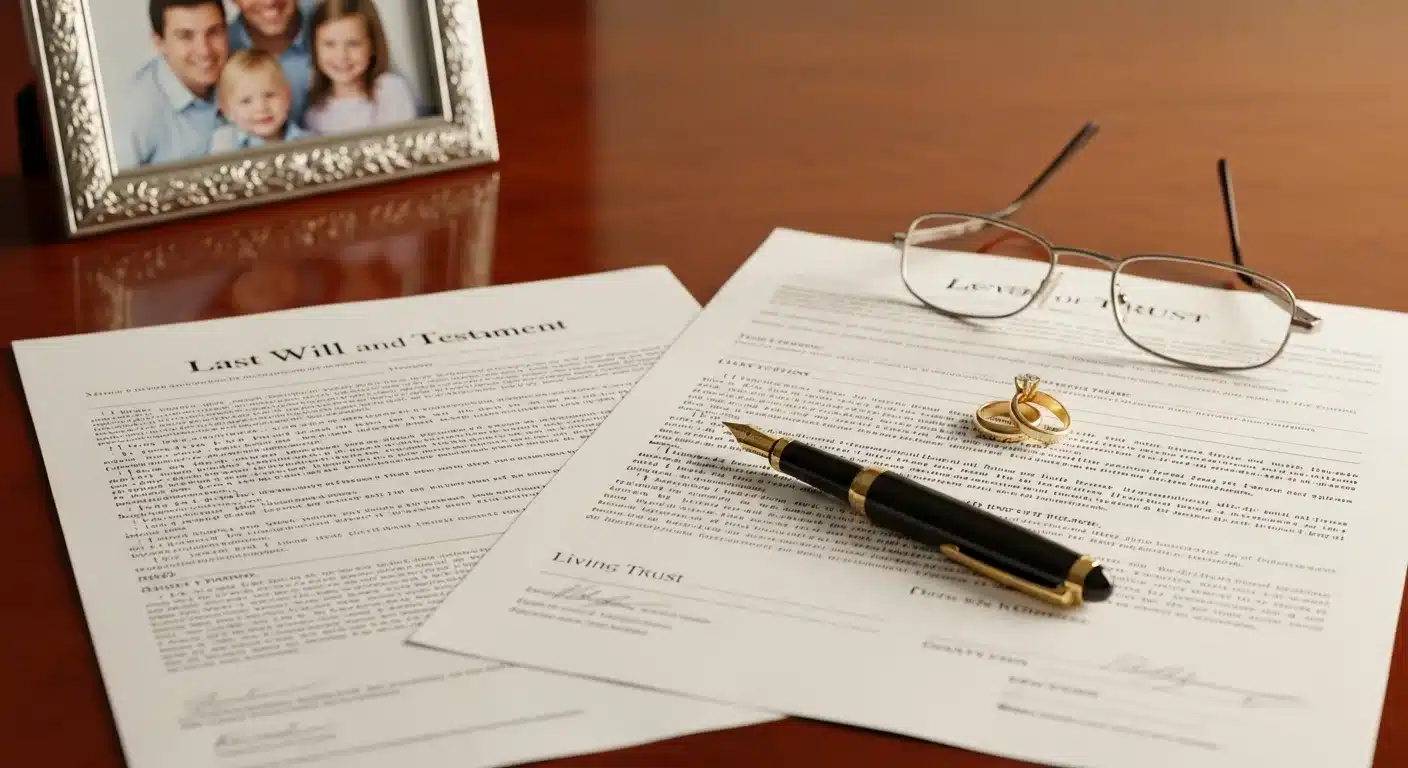
The answer lies in trust-based planning. A properly structured living trust allows you to provide income or housing for your surviving spouse during their lifetime while preserving the underlying assets (the principal) for your children.
Separate Property vs. Community Property
In California, it is essential to identify which assets are your separate property (owned before marriage or received as a gift/inheritance during marriage) and which are community property (acquired during the marriage). Under California Family Code §760, all property acquired during marriage is presumed to be community property unless you can prove otherwise.
Your separate property can be directed entirely to your children. Community property requires more careful planning because your spouse has an ownership interest in half of it.
Strategies for Protecting Your Children
- Create a revocable living trust with separate subtrusts that activate upon your death: one providing for your spouse and one preserving assets for your children
- Use a QTIP trust (explained in detail below) to give your spouse income while protecting the principal for your children
- Maintain separate property as separate by keeping inherited or pre-marital assets in separate accounts and documenting their character
- Fund life insurance to create a separate pool of assets specifically for your children, outside of the marital estate
- Name your children as direct beneficiaries on specific accounts (with careful coordination to avoid unintended consequences)
QTIP Trusts: The Cornerstone of Blended Family Estate Planning
A Qualified Terminable Interest Property (QTIP) trust is one of the most powerful tools available to blended families. It solves the fundamental tension between providing for a surviving spouse and protecting children from a prior marriage.
How a QTIP Trust Works
When you create a QTIP trust as part of your estate plan:
- Upon your death, specified assets transfer into the QTIP trust
- Your surviving spouse receives all income generated by the trust assets (interest, dividends, rental income) for the rest of their life
- The trustee may also distribute principal to your spouse for health, education, maintenance, and support, depending on how the trust is drafted
- When your surviving spouse passes away, the remaining trust assets go to your designated beneficiaries, typically your children from a prior marriage
The critical advantage: your surviving spouse cannot change who ultimately receives the trust assets. They benefit from the assets during their lifetime, but your children’s inheritance is legally protected.
Learn how Lawvex can help you set up a QTIP trust to protect your blended family.
QTIP Trust Benefits for California Blended Families
- Provides for your spouse: Your spouse maintains their standard of living through trust income
- Protects your children: The trust principal is preserved for your children regardless of what your spouse does after your death
- Estate tax advantages: QTIP trusts qualify for the unlimited marital deduction under Internal Revenue Code §2056(b)(7), deferring estate taxes until the surviving spouse’s death
- Creditor protection: Trust assets may be shielded from your surviving spouse’s creditors
- Remarriage protection: If your surviving spouse remarries, the trust assets are protected from the new spouse
Important QTIP Trust Considerations
QTIP trusts require careful drafting. Key decisions include:
- Whether the trustee can distribute principal to the surviving spouse (and under what circumstances)
- Who serves as trustee (a neutral third party is often advisable in blended family situations)
- How trust income is defined and distributed
- Whether the surviving spouse can live in real property held by the trust
Under California Probate Code §16000 et seq., trustees have fiduciary duties to all beneficiaries, both the income beneficiary (your spouse) and the remainder beneficiaries (your children). Selecting the right trustee is critical to avoiding conflicts.

Prenuptial Agreements and Estate Plans: Working Together
If you’re entering a marriage where one or both partners have children from prior relationships, a prenuptial agreement and an estate plan are not alternatives. You need both, and they need to work together.
What a Prenuptial Agreement Does for Estate Planning
A prenuptial agreement under California Family Code §1610-1617 can:
- Define separate vs. community property: Clearly establish which assets remain separate property, simplifying estate planning
- Waive spousal inheritance rights: Under California Probate Code §141-147, a spouse can waive their right to an elective share of the estate through a valid prenuptial or postnuptial agreement
- Protect pre-marital assets: Ensure that assets you bring into the marriage, or assets you inherit during the marriage, pass to your children
- Prevent transmutation claims: Without a prenup, commingling separate property with community property can cause it to lose its separate character under California Family Code §852
Coordinating Your Prenup With Your Estate Plan
Your prenuptial agreement and your estate plan must be consistent. If your prenup says your spouse waives inheritance rights, but your trust names your spouse as the primary beneficiary, you’ve created a conflict that could trigger litigation.
Work with an estate planning attorney who understands both documents. At Lawvex, we review prenuptial agreements as part of the estate planning process to ensure everything is aligned and enforceable.
Updating Beneficiary Designations: The Most Overlooked Step
This is where many blended family estate plans fail. You can have the most comprehensive trust in the world, but if your beneficiary designations on financial accounts contradict your trust, the beneficiary designations win.
Accounts With Beneficiary Designations
These assets pass directly to the named beneficiary, outside of your will or trust:
- Life insurance policies
- 401(k) and IRA retirement accounts
- Payable-on-death (POD) bank accounts
- Transfer-on-death (TOD) brokerage accounts
- Annuities
- Health savings accounts (HSAs)
The Blended Family Beneficiary Trap
Here’s a common scenario: You created your 401(k) during your first marriage and named your then-spouse as beneficiary. You divorced, remarried, and created a comprehensive estate plan leaving assets to both your new spouse and your children. But you never updated the 401(k) beneficiary designation.
Under federal law (ERISA), your current spouse may have automatic rights to your 401(k), regardless of what your old beneficiary designation says. But for IRAs, life insurance, and non-ERISA accounts, the named beneficiary controls. If your ex-spouse is still listed, they may receive the assets.
Critical Action Steps
- Audit every account that has a beneficiary designation immediately after remarriage
- Update designations to align with your current estate plan
- Consider naming your trust as beneficiary for some accounts (consult your attorney, as this has tax implications for retirement accounts)
- Review designations annually and after any major life change
- Keep copies of all beneficiary designation forms with your estate planning documents
California Community Property: What Blended Families Must Know
California is one of only nine community property states, and this has major implications for blended family estate planning.
The Basics of Community Property
Under California Family Code §760:
- Community property: Everything acquired during the marriage (with limited exceptions) is owned equally by both spouses, regardless of who earned or purchased it
- Separate property: Assets owned before marriage, plus gifts and inheritances received during marriage, remain the separate property of the individual spouse (Family Code §770)
- Commingling risk: If you mix separate property with community property (e.g., depositing an inheritance into a joint bank account), you may lose the separate character of those assets
Community Property Traps for Blended Families
Your home: If you owned your home before remarrying, it is your separate property. But if you use community funds (both spouses’ earnings during the marriage) to pay the mortgage, make improvements, or pay property taxes, your new spouse may acquire a community property interest in the home under California case law. Understanding Proposition 19’s property tax implications is also critical when transferring real property between family members.
Your business: A business started before marriage is separate property. But the increase in value during the marriage due to your labor (which is community effort) may create a community property claim.
Retirement contributions: Contributions to your 401(k) or pension during the marriage are community property, even if the account was opened during your first marriage.
Protecting Separate Property in a Blended Family
- Document everything: Keep records proving when and how you acquired assets
- Maintain separate accounts: Do not commingle separate property with community funds
- Use a transmutation agreement: Under California Family Code §852, spouses can agree in writing to change the character of property from community to separate (or vice versa)
- Title property correctly: How property is titled affects its legal character
- Work with an attorney: Community property tracing can be complex; professional guidance ensures your separate property stays separate
Building Your Blended Family Estate Plan: A Practical Checklist
If you’re part of a blended family, here are the essential steps for creating an estate plan that works:
- ☐ Inventory all assets and classify each as separate or community property
- ☐ Identify all beneficiaries: spouse, biological children, stepchildren, and any others
- ☐ Create or update your revocable living trust with provisions for both your spouse and your children (consider QTIP or other trust structures)
- ☐ Review your prenuptial agreement (if applicable) to ensure it aligns with your estate plan
- ☐ Audit and update all beneficiary designations on life insurance, retirement accounts, and financial accounts
- ☐ Execute updated powers of attorney and advance healthcare directives
- ☐ Discuss your plan with your family to set expectations and reduce future conflict
- ☐ Review and update your plan every 3 to 5 years or after any significant life change
Contact Lawvex to start building your blended family estate plan today.
When to Seek Professional Help
Blended family estate planning is not a do-it-yourself project. The intersection of California community property law, federal beneficiary designation rules, trust administration requirements, and family dynamics creates complexity that generic templates cannot handle.
An experienced estate planning attorney can help you navigate these issues and build a plan that truly protects everyone in your family. At Lawvex, we serve blended families throughout California, with remote consultations available statewide, with transparent pricing and a compassionate approach.
Ready to protect your blended family’s future? Learn more about our estate planning services or attend one of our free workshops to get started.
Frequently Asked Questions
Can my spouse change my estate plan after I die?
Your spouse cannot change the terms of your irrevocable trust or QTIP trust after your death. However, if you leave assets to your spouse outright (not in trust), they have full control over those assets and can distribute them however they choose. This is why trust-based planning is essential for blended families.
Do stepchildren automatically inherit in California?
No. Under California’s intestacy laws (Probate Code §6400 et seq.), stepchildren do not automatically inherit from a stepparent unless they were legally adopted. If you want your stepchildren to inherit, you must specifically include them in your estate plan. Learn more about how California inheritance laws work.
Can I disinherit my spouse in California?
You can disinherit your spouse from your separate property, but California community property laws give your spouse an ownership interest in half of all community property. You cannot disinherit your spouse from their half of the community property. However, a valid prenuptial or postnuptial agreement can modify these rights (Probate Code §141-147).
What happens if I don’t update my beneficiary designations after remarrying?
The consequences depend on the type of account. For employer-sponsored retirement plans governed by ERISA (like 401(k)s), your current spouse may have automatic rights regardless of the named beneficiary. For IRAs, life insurance, and other accounts, the named beneficiary on file receives the assets, even if it’s an ex-spouse you forgot to remove.
This article is for educational purposes only and does not constitute legal advice. Estate planning laws are complex and vary based on individual circumstances. Please consult with a qualified estate planning attorney to discuss your specific situation. Lawvex serves families in Clovis, Madera, and Solvang, California.