Estate Tax Exemption 2026: The New Rules Explained
April 9, 2026
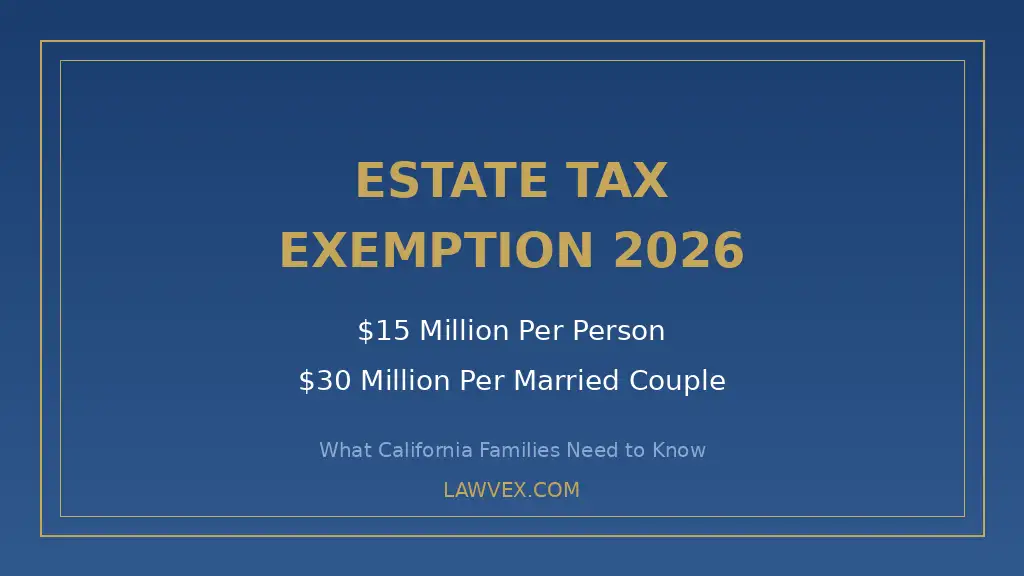
For years, the estate planning world was telling a scary story. It was about a “tax cliff” coming at the end of 2025, where the amount you could pass on tax-free would be cut in half. Many families rushed to make complex plans based on this deadline. Then, in a surprising plot twist, a new law changed the ending. The cliff disappeared. The new federal estate tax exemption 2026 is now a permanent $15 million per person. This article explains what this new chapter means, why those old plans might need a second look, and what every California family should focus on now. Families reviewing the new exemption can also explore Lawvex’s estate tax planning guidance.
The Estate Tax Sunset is Gone: What This Means for Your Plan
If you spent 2024 and early 2025 hearing about the looming estate tax exemption “cliff,” here is the update you need: the sunset never happened.
The Tax Cuts and Jobs Act (TCJA) of 2017 doubled the federal estate tax exemption from approximately $5.49 million to $11.18 million per person. That increase was always temporary, set to expire on December 31, 2025. Estate planners across the country spent years urging clients to “use it or lose it” before the exemption dropped back to roughly $7 million per person.
Then came the One Big Beautiful Bill Act (OBBBA), signed into law on July 4, 2025 as Public Law 119-21. Among its many provisions, the OBBBA permanently eliminated the TCJA estate tax sunset. The higher exemption is here to stay, and it continues to increase with inflation.
What Did the ‘One Big Beautiful Bill Act’ Actually Change?
The OBBBA removed the December 31, 2025 expiration date from the TCJA’s estate and gift tax provisions. Instead of reverting to the pre-TCJA baseline (approximately $7 million per person, adjusted for inflation), the exemption continued to rise. For 2026, the federal estate tax exemption is $15 million per individual and $30 million for married couples using portability.
This change is permanent and indexed for inflation, meaning the exemption amount will continue to increase each year based on IRS inflation adjustments.
A Quick Note on “Permanent” Changes
Let’s be honest, when you hear the word “permanent” in a political context, it’s smart to be a little skeptical. Laws can and do change. However, in the world of tax law, the “One Big Beautiful Bill Act” has made the new $15 million exemption as permanent as we can realistically expect. This isn’t just a temporary patch. The law establishes a new baseline and, crucially, ties it to inflation so it will continue to grow. This stability provides a solid foundation for long-term estate planning. It means you can create a strategy for your family’s future without the constant worry that the rules will be upended, which is a huge relief after the uncertainty we all felt leading up to 2026.
The New Numbers: $15M Per Person, $30M Per Couple
Here is how the federal estate tax exemption has evolved:
| Year | Individual Exemption | Married Couple (with Portability) | Key Event |
|---|---|---|---|
| 2017 (Pre-TCJA) | $5.49 million | $10.98 million | Pre-TCJA baseline |
| 2018 (TCJA enacted) | $11.18 million | $22.36 million | TCJA doubled the exemption |
| 2024 | $13.61 million | $27.22 million | Inflation-adjusted |
| 2025 | $13.99 million | $27.98 million | Final year before OBBBA |
| 2026 (OBBBA) | $15.00 million | $30.00 million | Made permanent by OBBBA |
For most California families, this means the federal estate tax is a non-issue. Only estates exceeding $15 million per person (or $30 million per married couple) will owe federal estate tax at the current rate of 40% on amounts above the exemption (IRC §2001(c)).
Don’t Forget the Generation-Skipping Transfer (GST) Tax
While the estate tax gets most of the attention, there’s another important tax to be aware of: the Generation-Skipping Transfer (GST) tax. This is a federal tax on money or property you give to individuals two or more generations younger than you, like your grandchildren. For 2026, the GST exemption is also $15 million per person, which aligns with the federal estate tax exemption. However, there’s a critical difference that can catch families by surprise. Unlike the estate tax exemption, the GST exemption is not “portable” between spouses. This means a surviving spouse cannot use any of their deceased spouse’s unused GST exemption.
This lack of portability is a major planning consideration. If a spouse dies without having allocated their full $15 million GST exemption to a trust, that exemption is lost forever. The surviving spouse is left with only their own $15 million exemption to cover all future gifts to grandchildren. For families who want to leave a lasting legacy for multiple generations, this can create an unexpected tax liability at a 40% rate. Proper estate planning is essential to structure trusts in a way that uses both spouses’ GST exemptions effectively, ensuring your wealth passes to your loved ones as you intend.
Federal Estate Tax Exemption 2026: The Key Figures
| Tax Provision | 2026 Amount |
|---|---|
| Federal estate tax exemption (individual) | $15,000,000 |
| Federal estate tax exemption (married couple with portability) | $30,000,000 |
| Federal estate tax rate (above exemption) | 40% |
| Annual gift tax exclusion (per recipient) | $19,000 |
| Annual gift tax exclusion (married, gift-splitting) | $38,000 |
| Lifetime gift & estate tax exemption | $15,000,000 per person |
| Exemption permanent? | Yes (inflation-indexed) |
How Is the Federal Estate Tax Calculated?
The federal estate tax applies to the gross estate minus allowable deductions. Your gross estate includes all assets you own or have an interest in at death: real property, bank accounts, investments, retirement accounts, life insurance proceeds, business interests, and personal property.
After subtracting debts, funeral expenses, charitable donations, and the marital deduction (for assets passing to a surviving spouse), the remaining taxable estate is compared against your available exemption. Only the amount exceeding your exemption is taxed at 40%.
Giving Gifts in 2026? Here Are the Tax Rules
The Annual Exclusion: Gifting Up to $19,000 Tax-Free
In 2026, you can gift up to $19,000 per recipient per year without using any of your lifetime exemption or filing a gift tax return. This is an increase from $18,000 in 2025, reflecting IRS inflation adjustments. Married couples who elect gift-splitting can give up to $38,000 per recipient jointly.
There is no limit on the number of recipients. A married couple with three children and six grandchildren could gift up to $342,000 per year ($38,000 × 9 recipients) without touching their lifetime exemption.
A Note on the $19,000 Amount
For 2026, the IRS has set the annual gift tax exclusion at $19,000 per recipient, per year. This is a bump up from the previous $18,000 limit, thanks to routine inflation adjustments. You can give this amount to as many people as you want—your kids, grandkids, or even a close friend—without it counting against your lifetime exemption. Best of all, you don’t have to file a gift tax return for these gifts, which keeps things simple.
If you’re married, you can team up through “gift-splitting” to give up to $38,000 per recipient together. This is a fantastic strategy for families across California—from Madera and Clovis down to Solvang—who want to support their loved ones. For instance, a married couple with three children and six grandchildren could give a total of $342,000 per year without using any of their lifetime exemption. It’s a powerful way to transfer wealth and an essential part of a comprehensive estate plan.
Your Lifetime Gift Tax Exemption Explained
The lifetime gift tax exemption is unified with the estate tax exemption. Any portion of the $15 million exemption you use for lifetime gifts reduces the exemption available at death. For most families, careful use of the annual exclusion is the more practical gifting strategy.
Who Pays the Gift Tax? (Hint: It’s the Giver)
This is one of the most common questions we hear, and the answer is simple. The person giving the gift (the donor) is responsible for filing a gift tax return and paying any tax that might be due. The recipient of your generosity doesn’t have to worry about it. According to the IRS, the person receiving the gift does not pay gift tax or income tax on its value. So, if you gift your child a down payment for a house, they won’t get a surprise tax bill. Remember, a gift tax return (Form 709) is only required if you give more than the $19,000 annual exclusion to any single person in a year. Even then, you likely won’t owe any tax; you’ll just be subtracting that excess amount from your $15 million lifetime exemption.
Special Rules for Gifting to a Non-U.S. Citizen Spouse
While you can give unlimited assets to your U.S. citizen spouse tax-free, the rules are different if your spouse is not a U.S. citizen. This is a critical exception that many people miss. For 2026, you can give up to $194,000 to your non-citizen spouse each year without it being a taxable gift. This amount is indexed for inflation and is a significant increase from the $185,000 limit in 2025. Any gifts above this amount will start to use up your lifetime gift and estate tax exemption. This rule exists to prevent assets from being transferred out of the country without ever being subject to U.S. estate tax. Proper estate planning, often involving a special trust called a QDOT, is essential for couples in this situation to ensure a smooth transfer of wealth.
Do I Need to File a Gift Tax Return (Form 709)?
You must file IRS Form 709 (United States Gift and Generation-Skipping Transfer Tax Return) if you make gifts exceeding the annual exclusion to any individual in a calendar year, or if you and your spouse elect gift-splitting. Filing Form 709 does not necessarily mean you owe gift tax; it simply reports the gift against your lifetime exemption.
You Can Now E-File Your Gift Tax Return
Here’s some good news for anyone who dreads paperwork: the process of filing a gift tax return just became much more convenient. The IRS now allows you to e-file Form 709, the U.S. Gift Tax Return, through its Modernized e-File (MeF) system. For years, this form had to be printed and mailed, a process that felt outdated and was often prone to delays. This update is a welcome change, as electronic filing is generally more secure and provides you with a quick confirmation that the IRS has received your return. It also tends to lead to more accurate and faster processing. While you still need to file if your gifts to an individual exceed the $19,000 annual exclusion, at least the administrative part of the task is now simpler.
What About Gifts from Covered Expatriates?
This is a niche but important rule to be aware of, especially in a globally connected state like California. If you receive a gift or inheritance from a “covered expatriate”—an individual who has renounced their U.S. citizenship—the tax rules are changing. Starting January 1, 2025, you, the recipient, may be subject to tax on that gift. This is a significant shift from the standard rule where the person giving the gift is responsible for any tax. This area of law is complex, and if you anticipate receiving assets from someone who has expatriated, it’s wise to seek professional guidance. Understanding the potential tax impact ahead of time can help you prepare and properly manage the inheritance process.
California Estate Tax Exemption 2026: What Residents Need to Know
Does California Have Its Own Estate Tax?
California has not imposed a state estate tax since 1982, when voters passed Propositions 5 and 6 eliminating it. California also has no state inheritance tax. This is a significant advantage compared to states like Washington (up to 20%), Oregon (up to 16%), or New York (up to 16%).
However, California residents remain subject to the federal estate tax on estates exceeding the $15 million per person exemption. And California’s high income tax rate (up to 13.3%) can apply to distributions from inherited retirement accounts like IRAs and 401(k)s.
How California Compares to States With an Estate Tax
Living in California means we don’t have to worry about a state-level estate or inheritance tax, which is a huge relief. While we still keep an eye on the federal rules, residents in many other states face an entirely separate layer of tax with its own set of complicated regulations. This can dramatically change the outcome of an estate plan and add significant costs for beneficiaries. To really appreciate California’s tax-friendly environment, it helps to see what families in other states are dealing with. New York provides a perfect example of how complex and costly a state estate tax can be, highlighting the benefits we enjoy as California residents.
A Look at New York’s Rules
New York not only has its own estate tax with a much lower exemption than the federal amount, but it also includes a harsh rule often called the “tax cliff.” If an estate’s value is more than 105% of the New York exemption threshold, the entire estate becomes taxable—the exemption vanishes completely. This is a stark contrast to the federal system, where tax is only due on the amount exceeding the exemption. Furthermore, New York does not allow for “portability,” meaning a surviving spouse cannot use their deceased spouse’s unused state exemption. For families throughout California, from Clovis to Madera and Solvang, not having to contend with these state-specific tax traps makes the estate planning process much more straightforward.
Community Property: What is the ‘Double Step-Up in Basis’?
California is a community property state, which provides a major tax benefit for surviving spouses. Under Internal Revenue Code Section 1014(b)(6), when one spouse dies, both halves of community property receive a stepped-up basis to the current fair market value.
In separate property states, only the deceased spouse’s share gets the step-up. In California, the full step-up applies to all community property. This can eliminate significant capital gains tax liability when the surviving spouse later sells inherited assets.
Example: A married couple in Clovis purchased their home for $200,000 twenty years ago. At the time of one spouse’s death, the home is worth $650,000. In California, the surviving spouse’s basis in the home steps up to the full $650,000. If they sell the home, they owe no capital gains tax on the $450,000 of appreciation. In a separate property state, only $225,000 of appreciation would have been eliminated by the step-up.
What is Portability and How Can It Help Your Spouse?
Portability allows a surviving spouse to use the deceased spouse’s unused estate tax exemption, called the Deceased Spousal Unused Exclusion (DSUE) amount. To claim portability, the executor must file Form 706 (Federal Estate Tax Return) within 9 months of death, even if no estate tax is owed.
With portability and the 2026 exemption, a married couple can effectively shelter up to $30 million from federal estate tax. For most families throughout California, this eliminates any realistic estate tax concern. However, portability does not apply to the generation-skipping transfer (GST) tax exemption, which is a consideration for families planning multi-generational wealth transfers.
How Prop 19 Changed Property Taxes for Heirs in California
While the federal estate tax exemption protects most California families from estate tax, Proposition 19 creates a separate property tax concern for inherited real estate.
Before Proposition 19 (effective February 16, 2021), children who inherited a parent’s home could keep the parent’s low property tax assessment regardless of whether they lived in the home. Under Prop 19, inherited property is reassessed to current market value unless the inheriting child uses it as their primary residence and files a homeowner’s exemption within one year of transfer.
Even if the child does move in, if the property’s current market value exceeds the assessed value by more than $1 million, the reassessment is partially adjusted upward. This can result in significant property tax increases for families inheriting homes in areas where values have appreciated substantially, including Clovis, Madera, and Solvang.
Proper estate planning can help families navigate Prop 19’s requirements and minimize property tax impacts on inherited real estate.
Will Heirs Pay California Income Tax on Inherited IRAs?
While California does not tax inheritances directly, inherited retirement accounts (IRAs, 401(k)s, 403(b)s) are subject to California income tax when distributions are taken. Under the SECURE Act, most non-spouse beneficiaries must withdraw all funds from inherited retirement accounts within 10 years of the account owner’s death.
With California’s top income tax rate of 13.3% (plus federal income tax), large inherited retirement accounts can generate substantial tax liability over the 10-year distribution period. Strategic planning around the timing of distributions can help minimize this impact.
What This Means for families throughout California
Are You at Risk for Estate Taxes in Clovis, Madera, or Solvang?
For most families throughout California, the $15 million per person exemption ($30 million for couples) means federal estate tax is not a practical concern. Consider a typical scenario:
- Primary residence in Clovis: $650,000
- Retirement accounts (IRA, 401k): $800,000
- Life insurance policy: $500,000
- Savings and investments: $300,000
- Personal property: $100,000
- Total estate: $2,350,000
This estate is well under the $15 million threshold. Even a more affluent family with a $1.2 million home, $2 million in retirement accounts, $1 million in investments, and a $1 million life insurance policy has a combined estate of $5.2 million, still far below the exemption.
Why Estate Planning Still Matters, Even Under $15 Million
Even though the estate tax does not apply to most families, estate planning is about far more than avoiding federal taxes. Without a proper estate plan, your family faces:
- California probate: Estates without a trust must go through probate, which takes 12 to 18 months and costs 4% to 10% of the estate value in attorney and executor fees under California Probate Code §10810-10811
- No healthcare decision guidance: Without an advance healthcare directive, your family has no legal authority to make medical decisions if you become incapacitated
- Property tax reassessment: Prop 19 can increase property taxes on inherited homes if not properly planned for
- Family conflict: Without clear instructions, inheritance disputes can divide families
- No financial management: Without a durable power of attorney, no one can manage your finances if you are unable to do so
A revocable living trust avoids probate entirely, provides incapacity planning, and gives your family clear instructions for managing and distributing your assets.
Handling the Paperwork: Key IRS Rules and Updates
Even with the high federal exemption, settling an estate involves a surprising amount of paperwork. Whether you are a trustee managing a trust or an executor navigating probate, you will interact with the IRS. Staying current on their rules is essential for a smooth process and avoiding future tax headaches. Fortunately, the IRS has made a few updates that can simplify things for families and their legal advisors. Here are a few key rules and changes you should know about as you handle the financial side of an inheritance.
Consistent Basis Reporting: A Must-Know for Heirs
When you inherit property like a house or a stock portfolio, it gets a new “basis” for tax purposes, which is typically its fair market value on the date of the original owner’s death. This is the number you’ll use to calculate capital gains if you ever sell the asset. The IRS has a critical rule here: the basis you use as an heir must match the value reported on the estate tax return. This rule on consistent basis reporting ensures everyone is on the same page and prevents discrepancies that could trigger an audit. Working with an experienced attorney during the trust administration process ensures all assets are valued correctly and reported consistently, protecting you from potential tax issues down the road.
Requesting an Estate Tax Closing Letter
An Estate Tax Closing Letter (IRS Letter 627) is the official document from the IRS that confirms they have accepted the estate’s tax return (Form 706) and that the estate is closed from a federal tax perspective. For a trustee or executor, this letter is the final piece of the puzzle, providing peace of mind that no further tax is owed. It formally concludes the estate’s business with the IRS. The IRS recently made this process a little easier by reducing the user fee to request this letter. While the fee change is minor, the letter itself is invaluable for officially closing out the estate and making final distributions to beneficiaries without the fear of a future IRS claim.
How Your Attorney Can Access Tax Information Faster
Waiting on the IRS can be one of the most frustrating parts of settling an estate. To speed things up, the IRS has introduced a Transcript Delivery Service (TDS) that allows authorized tax professionals to get immediate access to crucial tax information. This means your attorney can view and print estate tax account transcripts instantly, rather than waiting weeks for documents to arrive by mail. This direct access can significantly expedite the process of verifying tax compliance and moving forward with the estate or probate administration. It’s a perfect example of how having a professional on your side can make a complex process more efficient, saving you time and reducing stress during an already difficult period.
If You Already Planned for the Sunset: What to Do Now
Many families took proactive steps in 2024 and early 2025 to “use” the high exemption before the anticipated sunset. If you were one of them, here is what you need to know.
What About Gifts Made Before the Law Changed? (The Anti-Clawback Rule)
If you made large gifts in 2024 or 2025 to reduce your taxable estate before the sunset, those gifts are fully protected. The IRS finalized the anti-clawback rule in Treasury Regulation §20.2010-1(c), which ensures that gifts made during the high-exemption period are not recaptured even if the exemption later decreases.
Since the OBBBA actually increased the exemption to $15 million (from $13.99 million in 2025), your gifts simply reduced your available lifetime exemption. There is no adverse tax consequence.
Should You Revisit Your SLAT or Irrevocable Trust?
Spousal Lifetime Access Trusts (SLATs) and other irrevocable trusts created to shelter assets before the sunset are still valid and functional. These trusts continue to provide asset protection, generation-skipping benefits, and potential income tax advantages. However, some families may find that the urgency that motivated these trusts has diminished now that the exemption is permanent at $15 million.
Is Your A/B Trust Now Too Complicated?
A/B trust splitting (also called bypass trust or credit shelter trust planning) was a standard strategy when exemptions were lower. These structures split a married couple’s trust into two sub-trusts at the first spouse’s death to maximize the use of both exemptions. With a $30 million combined exemption and portability, many A/B trusts are now unnecessarily complex and may restrict the surviving spouse’s access to assets without meaningful tax savings.
If your estate plan includes A/B trust provisions, consult with an estate planning attorney to determine whether simplifying your plan makes sense for your family’s situation.
Estate Planning Moves to Make for 2026
Using a Revocable Living Trust to Avoid Probate
For families throughout California, a revocable living trust remains the single most important estate planning tool. California probate is expensive (statutory attorney and executor fees under Probate Code §10810 can reach 4% on the first $100,000 of the estate and decrease from there) and time-consuming (12 to 18 months on average). A funded revocable trust bypasses probate entirely, saving your family time, money, and stress.
Protecting Your Assets with an Irrevocable Trust
Even without estate tax concerns, irrevocable trusts serve important purposes including creditor protection, Medi-Cal planning (subject to the 30-month look-back period under California law as of January 1, 2024), and protecting assets for beneficiaries with special needs or spending concerns. Under California Probate Code §§15400-15414, irrevocable trusts cannot be modified or revoked without specific legal processes.
How to Use Annual Gifting to Your Advantage
Taking advantage of the $19,000 annual gift tax exclusion is a simple, effective strategy for gradually reducing your estate while supporting your family during your lifetime. Gifts to 529 education savings plans can be front-loaded up to five years ($95,000 per beneficiary) without using your lifetime exemption.
The Role of Life Insurance in Your Estate Plan
Life insurance proceeds are included in your gross estate if you own the policy at death. For families with estates approaching the $15 million exemption, an irrevocable life insurance trust (ILIT) can hold the policy outside your estate, keeping the proceeds from triggering estate tax liability.
Planning for Your Business’s Future
Business owners throughout California should consider business succession planning as part of their estate strategy. Buy-sell agreements, entity structuring, and valuation discounts for family-owned businesses can facilitate smooth transitions while minimizing tax impacts.
Tax-Smart Ways to Give to Charity
Charitable giving can reduce your taxable estate while supporting causes you care about. Donor-advised funds, charitable remainder trusts, and direct bequests all provide estate tax deductions. For families who made large gifts before the OBBBA and now have fewer tax concerns, redirecting future planning toward charitable strategies can be particularly effective.

New Deduction for Non-Itemizers
The OBBBA introduced a welcome change for people who take the standard deduction instead of itemizing. If you fall into this group, you can now take an above-the-line deduction for direct cash gifts to qualified charities. For 2026, you can deduct up to $1,000 for individuals and $2,000 for married couples filing jointly. This is a straightforward way to get a tax benefit for your generosity without the complexities of itemizing. It’s important to note that this special deduction only applies to direct cash contributions; gifts made to donor-advised funds or private foundations do not qualify for this specific benefit.
New Threshold for Itemizers
For those who do itemize their deductions, the rules for charitable giving have a new floor. Starting in 2026, you can only deduct charitable contributions that exceed 0.5% of your adjusted gross income (AGI). For example, if your AGI is $200,000, the first $1,000 of your charitable gifts for the year would not be deductible. Only the amount you give above that $1,000 threshold can be claimed. This change may encourage a strategy known as “bunching,” where you consolidate several years’ worth of donations into a single year to surpass the threshold and maximize your deduction.
A Cap for High-Income Earners
The new law also places a limit on the tax benefit of charitable deductions for those in the highest income tax bracket. In 2026, this applies to individuals earning over $640,600 and joint filers earning over $768,700. While their top income tax rate is 37%, the value of their charitable deduction is now capped at 35%. In simple terms, this means they will receive slightly less tax savings for every dollar they donate compared to the previous rules. While this is a subtle change, it’s a key consideration for high-net-worth individuals who incorporate significant charitable giving into their estate planning strategy.
What is a Charitable Remainder Trust (CRT)?
If you are charitably inclined, a charitable remainder trust lets you remove appreciated assets from your estate, receive an income stream for life, and claim a partial income tax deduction, all while supporting a cause you care about. CRTs can be especially useful for families holding highly appreciated California real estate or concentrated stock positions.
Frequently Asked Questions
What is the federal estate tax exemption for 2026?
The federal estate tax exemption for 2026 is $15 million per individual ($30 million for married couples using portability). The One Big Beautiful Bill Act, signed July 4, 2025, made this exemption permanent and indexed for inflation.
Did the estate tax exemption sunset in 2026?
No. The TCJA estate tax exemption was originally scheduled to sunset on December 31, 2025, which would have dropped the exemption to approximately $7 million per person. The One Big Beautiful Bill Act (Public Law 119-21) eliminated the sunset, making the higher exemption permanent.
What is the annual gift tax exclusion for 2026?
The annual gift tax exclusion for 2026 is $19,000 per recipient ($38,000 for married couples using gift-splitting). This increased from $18,000 in 2025 due to IRS inflation adjustments. Gifts within this amount do not require a gift tax return.
Does California have an estate tax?
No. California has not had a state estate tax since 1982 and has no state inheritance tax. However, California residents are still subject to the federal estate tax on estates exceeding $15 million per person. California income tax (up to 13.3%) may also apply to distributions from inherited retirement accounts.
What happens to gifts I made in 2024-2025 before the OBBBA?
Those gifts are fully protected. The IRS anti-clawback rule (Treasury Regulation §20.2010-1(c)) ensures gifts made during the high-exemption period cannot be recaptured. Since the exemption actually increased to $15 million, your previous gifts simply reduced your available lifetime exemption with no adverse tax consequence.
Should I update my estate plan after the One Big Beautiful Bill?
Yes. If your estate plan was designed around the anticipated TCJA sunset, particularly if it includes A/B trust splitting, SLATs, or aggressive gifting strategies, you should have your plan reviewed. The permanent $15 million exemption may mean your plan can be simplified while still achieving your goals.
How does California’s community property affect estate planning?
California’s community property laws provide a significant tax advantage: both halves of community property receive a full step-up in basis when one spouse dies under IRC §1014(b)(6). This can eliminate substantial capital gains tax liability when the surviving spouse sells inherited assets, making California one of the most favorable states for inherited property.
What is Proposition 19 and how does it affect inherited property?
Proposition 19 (effective February 2021) changed California property tax rules for inherited homes. Unless the inheriting child uses the property as their primary residence and files within one year, the property is reassessed to current market value. This can result in significant property tax increases, particularly in areas of California with substantial appreciation.
Do I still need an estate plan if my estate is under $15 million?
Absolutely. Estate planning addresses far more than estate taxes. Without a trust, your family faces California probate (12 to 18 months, 4% to 10% of estate value in costs), has no guidance for healthcare decisions during incapacity, and may encounter property tax reassessment under Prop 19. A comprehensive estate plan protects your family regardless of your estate’s size.
What is portability and how does it work with the $15 million exemption?
Portability allows a surviving spouse to use the deceased spouse’s unused estate tax exemption (the DSUE amount). To claim it, the executor must file Form 706 within 9 months of death, even if no estate tax is owed. With portability, a married couple can effectively shelter $30 million from federal estate tax.
Ready to Protect Your Family’s Future?
The permanent $15 million estate tax exemption is good news for most California families. But it does not eliminate the need for thoughtful estate planning. Probate avoidance, incapacity planning, Prop 19 compliance, and family protection are just as important as ever.
Whether you need to create your first estate plan, update an existing plan that was designed around the TCJA sunset, or review your trust administration strategy, the team at Lawvex can help. We serve families throughout California, with remote consultations available statewide and in-person services available through our offices in Clovis, Madera, and Solvang.
Attend a Free Workshop | Download Our Estate Planning Checklist | Free Resources
This article is for educational purposes only and does not constitute legal advice. Tax laws are complex and subject to change. Consult with a qualified estate planning attorney and tax professional regarding your specific situation. Last updated April 2026.
Key Takeaways
- The Federal Estate Tax Is Likely a Non-Issue: With the exemption permanently set at $15 million per person, the vast majority of California families no longer need to worry about federal estate taxes, which simplifies the planning landscape significantly.
- Focus on California-Specific Issues: Your planning should now center on state-level concerns. A revocable living trust is key to avoiding California’s costly probate system, and smart planning is needed to handle the property tax reassessments caused by Prop 19.
- Review Any Pre-2026 Estate Plans: If you created a complex trust to prepare for the old tax laws, it’s time for a checkup. Your plan may be unnecessarily complicated now, and simplifying it could give your family more flexibility and control.